“Seulement” Soaking Horn: Ms. Fr. 640’s Recipe for Softening Horn
Sophie Kerwin
Fall 2025
HIST GU4962: Making and Knowing in Early Modern Europe
1. Introduction
Prior to the development of hydrocarbon-based plastics, horn functioned as a kind of proto-plastic. Indeed, horn, the keratinous tissue that covers the bony core on the heads of certain bovine and ovine animals, shares a similar chemical structure to some modern thermoplastics, which enables it to be manipulated when heat is applied and to re-harden when cooled. Thus, when England’s historic guild of horners, the Worshipful Company of Horners, found their craft imperiled by the development of numerous plastics substitutes, they chose to ally themselves with the growing plastic industry. They officially partnered with Britain’s plastic industries in 1943 and continue to promote the study and development of the latest plastic technology and to grant awards for innovation and design in the industry.1 Long before the development of today’s plastics, however, artisans understood and exploited the natural plastic qualities of horn. As early as the second century CE, Pausanias writes that “fire turns the horns of oxen and elephants from curved to straight, and also into other shapes.”2 In medieval and early modern Europe, artisans softened horn to fashion a wide variety of products: lantern panes, combs, game pieces, beads, knife handles, spoons, inkwells, and other kinds of little dishes and boxes. 3
Across various books of secrets and technical, artisanal, and alchemical treatises, a number of recipes describe processes for softening horn. The author-practitioner of Ms. Fr. 640 includes one such recipe on folio 15v of his manuscript (fig. 1). In this essay, I first explore the origins, aims, materials, tools, and processes of this brief recipe through textual analysis, historical research into horn working, and comparison with surviving objects and recipes. I then attempt an experimental reconstruction to test Ms. Fr. 640’s recipe and two others for proof of concept and to better understand the knowledge of and attitude towards the material properties of horn embodied in these recipes. Among a large body of recipes that appear to test the material limits of horn, Ms. Fr. 640’s recipe stands out for its relative straightforwardness. Rather than attempting a transformation of horn through art or alchemy, the recipe seems designed to unlock horn’s innate mutability by the simplest means necessary, means already tested by specialized practitioners and designed for very specific ends.
2. The Recipe: Ms. Fr. 640’s Recipe to “Ramolir La Corne”
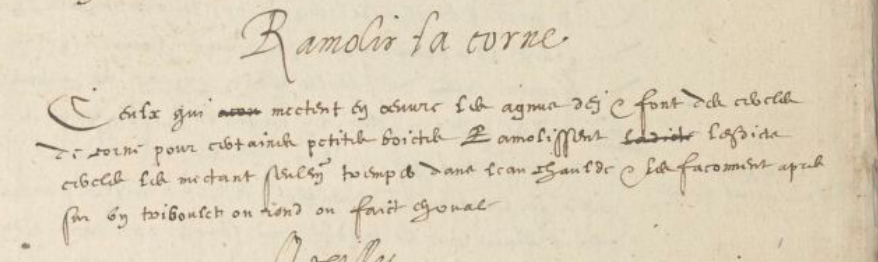
Figure 1: Recipe to “Ramolir La Corne.” Making and Knowing Project,
Pamela H. Smith, Naomi Rosenkranz, Tianna Helena Uchacz, Tillmann Taape,
Clément Godbarge, Sophie Pitman, Jenny Boulboullé, Joel Klein, Donna
Bilak, Marc Smith, and Terry Catapano, eds., Secrets of Craft and
Nature in Renaissance France. A Digital Critical Edition and English
Translation of BnF Ms. Fr. 640 (New York: Making and Knowing Project,
2020), f. 15v. [https://edition640.makingandknowing.org]
| Ramolir la corne | Softening horn |
|---|---|
| Ceulx qui acou mectent en oeuvre les agnus dei & font des cerclesde corne pour certaines petites boictes ramolissent ladictelesdictscercles les mectant seulem{ent} tremper dans l’eau chaulde& les façonnent apréssur un triboulet en rond ou faict en ovale. | Those who acou mount Agnus Dei & make circles from horn for certain little boxes soften ladicte the said circles simply by soaking them in hot water and next fashion them on a round or oval-shaped triblet. |
2.1. Who: “Ceulx qui…”
While the author-practitioner’s recipe for softening horn is quite
brief, running only four lines long, he makes a point of describing
those who might make use of softened horn quite specifically. Indeed,
rather than addressing the recipe to “you” or “one” or referring to the
process described as being carried out by “some” or “others” as he does
elsewhere, the author-practitioner identifies the process as one
performed by a very specific group of practitioners who produce
particular products: “Ceulx qui ~~acou ~~mectent en oeuvre les agnus dei
& font des cercles de corne pour certaines petites boictes” (Those who
acou mount Agnus Dei & make circles from horn for certain little
boxes).
Who is this “ceulx”? Who mounted agnus dei and made circles from horn for certain little boxes? A number of artisans at work in medieval and early modern France made use of horn in their production. In Étienne Boileau’s Livre des métiers, a record of Parisian guild regulations written in the last decade of Louis IX’s reign (1260–70), the métiers are defined not by their raw material but by the objects they produced. Thus, the “pingniers” and “lanterniers” (combmakers and lantern makers), the “patenotriers” (bead makers), “couteliers” (knife-handle makers), “deiciers” (dicemakers), “tabletiers” (makers of writing tablets), and “imagiers” (sculptors) all used horn, as well as ivory, bone, wood, and other materials, in crafting their diverse products.4 While the tabletier is narrowly defined as a maker of writing tablets, Elizabeth Sears and Sarah Guérin’s work on medieval ivory carving suggests that the tabletier’s work extended far beyond this.5 Guérin argues that the tabletier’s skills in sawing meant that they came to specialize in the preparation of panels and tablets not only for use in their own production but for other crafts as well. A 1485 amendment to Boileau’s regulations, which addresses “tous pigniers, tabletiers, tailleurs d’ymages et tourneurs, touchant ledit mestier de tabletier” (all comb makers, makers of writing tablets, carvers of images, and turners, which touch upon the said métier of the tabletier) suggests that by the end of the fifteenth century these varied professions were closely associated with that of the tabletier.6
Similarly, Katherine Baker’s recent analysis of the sixteenth-century tabletier Chicart Bailly’s inventory has shed new light on the profession and makes clear that the tabletier processed the raw materials for producing a variety of objects using ivory, bone, horn, and wood and for supplying other craftsmen.7 By the eighteenth century, when Denis Diderot documented the materials, tools, and workspaces of the “tabletier-cornetier” in his Encylopédie, tabletiers appear to have run large-scale workshops with large presses for producing flattened sheets of horn at scale.8 Adele Schaverien describes a similar situation in England where it is “difficult to determine whether a horner in medieval times carried out the entire process from horn to finished object, or only produced the pressed or split horns providing the semi-manufactured sections of horns to other craftsmen.”9 By the eighteenth century, however, the historian John Strype described the horners as preparing “Horns for other petty Manufacturers, as for those that make Lanthorns, Inkhorns, Giggs, Spoons, small Dishes, and other Things of Horn.”10
Thus, the skilled “ceulx” of the recipe may refer to a tabletier but, given the specificity of products listed, it might also refer to one of the highly specialized manufacturers who made use of horn prepared by the tabletier. Indeed, when the author-practitioner uses the phrase “ceulx qui” to introduce a material process, it is often in service of making a distinction between general knowledge or practice and the specific knowledge or technique he offers. This sometimes involves regional distinctions as in the recipe to “Paindre a huile desmail dazur” (Painting esmail d’azur in oil), where he refers to “ceulx qui en allemaigne le font” (those who make it in Germany) as preparing it in a specific fashion. 11 In other cases, it involves quite particular forms of professional knowledge or expertise, as in the recipe for “Gect de plomb” (Casting of Lead) where he refers to “Ceulx qui gectent ces petits ouvrages qui se vendent devant les eglises” (Those who cast those small works that are sold in front of churches)12 and as appears to be the case here. In all these instances, “ceulx qui” seems to operate as a special marker, indicating a specialized form of material or technical knowledge made available to the author and recorded here for the reader of his text.
2.2. Why: Mounting Agnus Dei and Making “Certain Little Boxes”
In identifying who softens horn in this manner, the author-practitioner also lists the uses to which such softened horn might be put. To better understand the process described, it is useful to envision the kind of products he references. He first mentions mounting agnus dei or wax discs imprinted with the image of a lamb and blessed by the Pope. Sophie Pitman has previously identified an example of an agnus dei mounted between two discs of horn and encased in silver dating to the fifteenth century in the Victoria and Albert Museum (fig. 2).13 As in lanterns, the horn’s natural translucency would allow for viewing the agnus dei while its hardness would protect the wax impression.14 From the Victoria and Albert Museum example, however, it is unclear why shaping or rounding the horn would be necessary rather than simply cutting flattened horn sheets into circular discs. The author-practitioner might therefore be referring to a slightly different type of mounting or encasing, but I have not yet found any examples of agnus dei pendants with rounded elements or other mentions of their preparation.
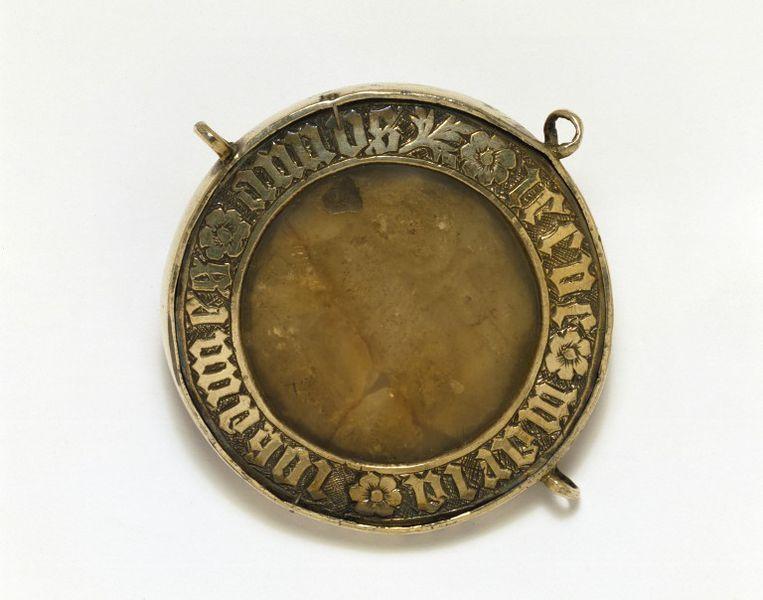
Figure 2: Agnus Dei pendant, ca. 1400–1450, German artist. Silver,
silver gilt, wax, and horn, 5.8 cm diameter. Victoria and Albert Museum,
London, 833-1891.
Permalink: http://collections.vam.ac.uk/item/O324919.
The author-practitioner also states that the softened horn might be used for making circles for “certaines petites boictes” (certain little boxes). Beginning in the seventeenth and eighteenth centuries, in particular, a large number of snuff boxes in round and oval forms began to be produced in horn (fig. 3) Many boxes were also impressed with designs as will be discussed in greater detail below (fig. 4). Paula Hardwick argues that while such boxes tend to be referred to generically as “snuff boxes,” they likely served a variety of purposes before and after snuff’s popularity.15 Indeed, another sixteenth-century recipe for softening horn similarly describes its use in fashioning “les manches des couteaus, les pignes, & les echets. Les boictes & bouteilles pour mettre l’encre & autres cases & etuis” (the handles of knives, combs, and chess pieces. Boxes and bottles for holding ink and other cases and containers).16 The earliest surviving examples of boxes and inkhorns impressed with images, dating to the fifteenth and sixteenth centuries, tend to be religious in nature (fig. 5),17 which might explain why the author-practitioner describes an artisan specializing in both mounting agnus dei and making boxes. The author-practitioner’s use of the word “certaines” (certain), which he employs throughout the manuscript to describe highly specific materials, processes, actors, and properties, again implies a very particular and limited production.18
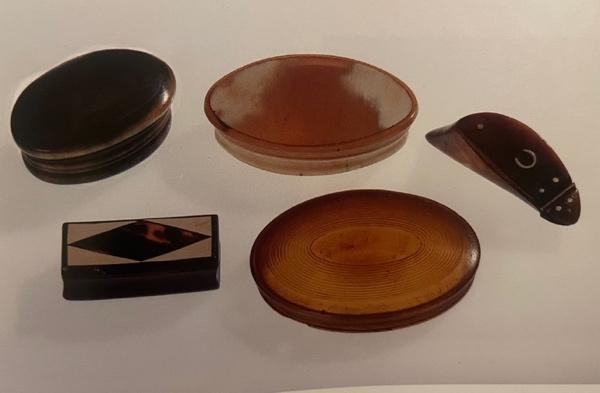
Figure 3: Selection of 19th century horn snuff boxes,
including round and oval examples. Private
collection.
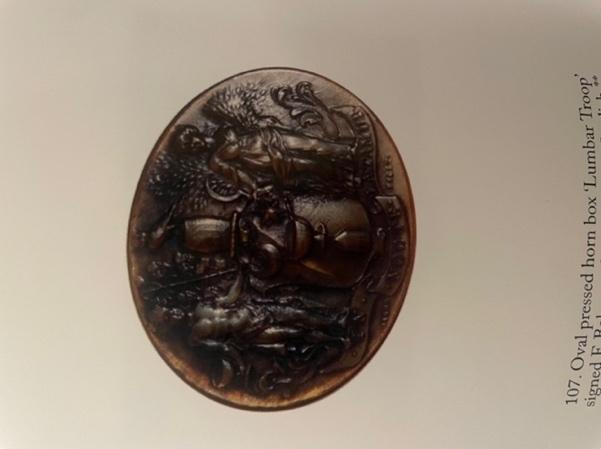
Figure 4: Oval pressed horn box ‘Lumbar Troop.’ Signed F. Baker.
Mid-eighteenth-century English. Horners’ Co.
Collection.
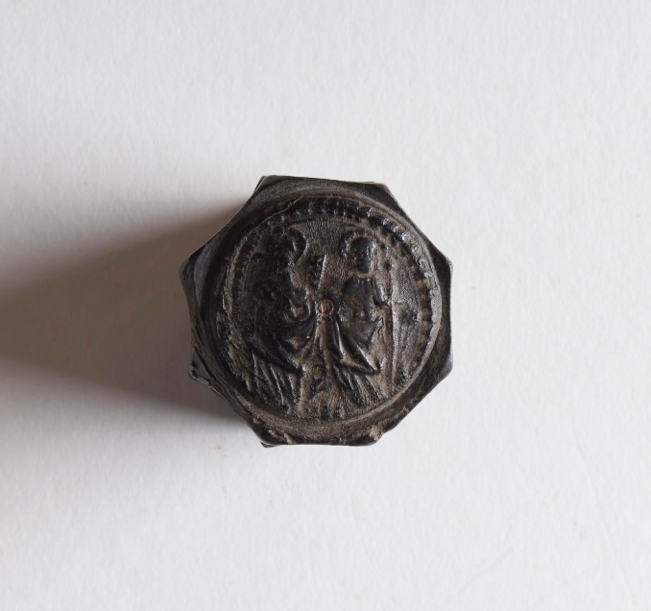
Figure 5: Inkpot with saints, late 15th-16th
century. Pressed horn. Height: 4.5 cm, diameter 3.8 cm. Museum of
London,
4884.
2.3. What: Materials and Tools
Notably, the author-practitioner does not specify the kind of horn to be used or its state of preparation. As he does not describe or even allude to any preliminary processing, it seems likely that the recipe is meant to be performed with pre-processed horn. Indeed, in other recipes involving horn in Ms. Fr. 640 (for use as counterfeit jasper and inlay in fanciful tables), the author-practitioner explicitly advises using the prepared horn sheets ready to be employed by the lantern maker.19 The initial preparation of the horn into flattened sheets would have already involved softening on the part of the tabletier. These processes are later documented quite extensively in Diderot’s Encylopédie’s section on the “tabletier-cornetier,” mentioned above. As illustrated in plate I, which represents an idealized view of a tabletier’s workshop, the horn was heated at the workbench or over the hearth, then cut, split open, and pressed into flat sheets with the aid of a press (fig. 6). In plate II, the bottom row illustrates, for example, horn that has been heated, cut, opened, and flattened for the press to be made into a comb (fig. 7). Forming certain products like boxes from these flattened sheets would have involved additional heating and molding by the tabletier or specialized manufacturer. This additional step seems to be the process described by the author-practitioner in his recipe.
Once resoftened, the horn could then be molded into the desired final shape. The author-practitioner advises shaping on “un triboulet en rond ou faict en ovale” (a round or oval-shaped triblet). This is the only mention of such a tool in the manuscript, which seems to suggest that this information has been communicated to the author and recorded here rather than carried out himself with his own tools.
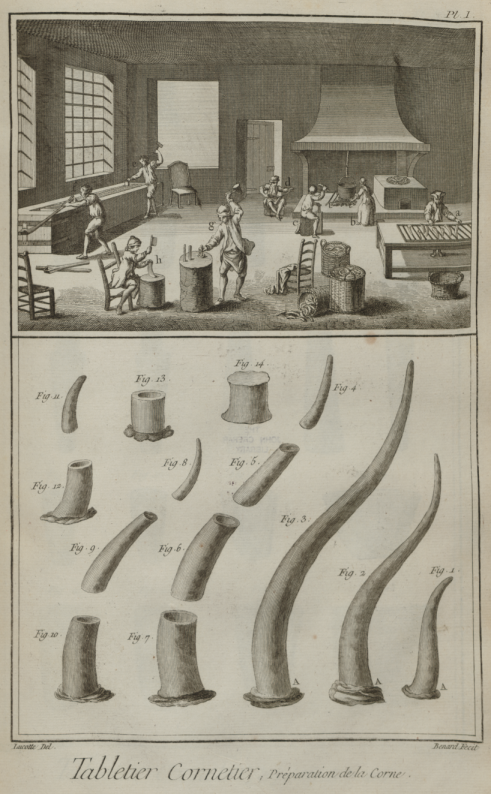
Figure 6: Tabletier Cornetier, Préparation de la Corne, in Denis and
Jean le Rond d’Alembert, eds. Encyclopédie ou Dictionnaire raisonné des
sciences, des arts et des métiers, Planches, vol. 9 (Paris, 1765),
plate
I.
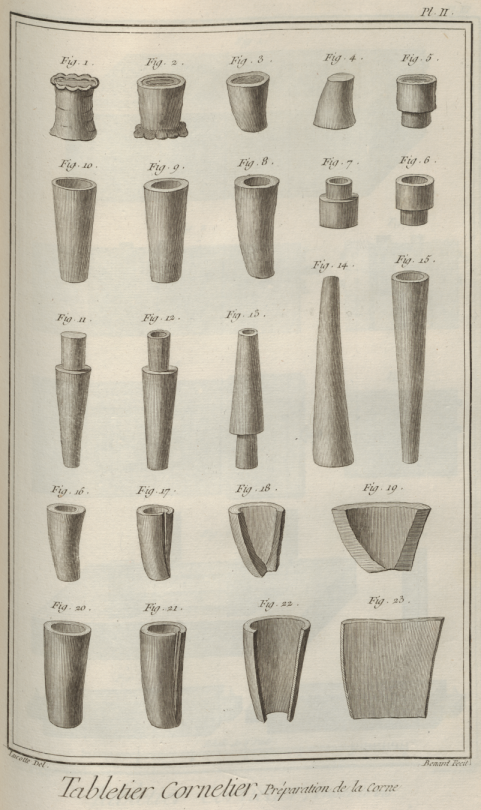
Figure 7: Tabletier Cornetier, Préparation de la Corne, in Denis
Diderot and Jean le Rond d’Alembert, eds. Encyclopédie ou Dictionnaire
raisonné des sciences, des arts et des métiers, Planches, vol. 9
(Paris, 1765), plate II.
2.4. How: “Seulement” Soaking Horn
Compared to the specificity with which he identifies who softens horn and the products that they make with it, the author-practitioner describes the actual process of softening very briefly. He advises: “seulem{ent} tremper dans l’eau chaulde & les façonnent après sur un triboulet en rond ou faict en ovale” (simply soaking them in hot water and next fashioning them on a round or oval-shaped triblet). When compared to other recipes where the author’s direct experimentation is made clear through extensive commentary or marginalia, the brevity of the recipe again suggests that this information may have been communicated to the author-practitioner rather than reflecting his own experience with the process described.
The brevity of the description also suggests the tacit and embodied knowledge of the artisan who has communicated this information. The process might be “simple” for an artisan who specializes in this craft but for an inexperienced practitioner or modern researcher attempting a historical reconstruction, the gaps in assumed knowledge become immediately clear. The author-practitioner does not specify, for example, the temperature to which the water must be heated or the length of time that the horn must be soaked. He only describes the water as “chaulde.” While this has been translated as “warm” in this recipe, it has elsewhere been translated as “hot” and indeed seems to be used to describe a range of temperatures across the manuscript. He also does not specify how long the horn should be soaked for and whether the water should be continually heated throughout this process. While it would seem necessary to continue to heat the water to keep it warm, he does not explicitly advise one to “bouillir” (boil), “doucement bouillir” (gently boil), or “fremir” (simmer) as he does in other recipes. He instead uses the word “tremper” (soak).
Historian and horner Adele Schaverien emphasizes the importance of heating horn to the proper temperature as too little heating will not allow for shaping but excessive heating can begin to break down and dissolve the horn or render it brittle and inflexible. She provides an approximate temperature as an aid to “the novice horner,” but describes a nineteenth century account of a horner’s workshop, when a horner was asked “How hot the horn should be” before pressing and replied, “when it is too hot to handle.”20 Thus, the expert horner developed their sense of the necessary temperature through practice, embodied experience, and even pain. While the recipe does not include explicit references to such sensory details or cues, this kind of tacit and embodied knowledge likely lies behind the briefly described process and its assumption of knowledge that does not need to be precisely communicated here.
2.5. “Another Way”: Other Recipes for Softening Horn
While the author-practitioner only provides one means by which to soften horn and indeed seems to emphasize that this relatively straightforward process is all that is required at least for those making the products he so narrowly describes, a number of other texts offer alternative means. The sixteenth-century Italian polymath Girolamo Cardano’s books, for example, contain a recipe for softening horn, which he describes as an alchemical art, through soaking it in water with a little wood ash for eight hours.21 The Allerley Matkel, a sixteenth-century technical book primarily devoted to spot removing and dyeing, also contains a number of recipes for softening horn.22 The first recipe “to make horn soft” involves boiling horn in a lye made from month-old urine, unslaked lime, willow ashes or ashes of wine lees, tartar, and salt or alternatively ashes of burnt poppies and their stems. Additional recipes offer further alternatives “to soften horn so much that it can be worked into new forms,” “another recipe of the same kind,” and “to pour horn in molds like lead,” all of which involve mixing horn chips into various lye solutions to form a paste. Ms. H 1435, a sixteenth or seventeenth-century Hebrew alchemical manuscript at John Rylands Library in Manchester similarly contains multiple recipes for softening horn, bone, and ivory and one “to pour horn into a mold.”23 In his Le nouveau recueil de curiositez rares & nouvelles des plus admirables effets de la nature & de l’art (1685), the apothecary to the French king, Nicholas Lémery, includes yet another variation of a recipe for softening horn through a differently composed lye.24 In the final line, Lémery states that horn pieces placed in this mixture will “fondrent” or melt and the contemporary English translation of this recipe is titled “To soften or dissolve Horn.”25
Despite the preponderance of surviving recipes, modern scholars have debated whether these methods were really employed or indeed necessary for manipulating horn.26 Speaking from her own experience as a horner, Schaverien argues that making boxes impressed with images, which came to be popular in the seventeenth and eighteenth centuries, would have likely involved some kind of preliminary softening as described in these recipes. However, she dismisses Ms. 1435’s alchemical recipe to “pour horn into a mould” as “intriguing” but “highly unlikely.”27 Her skepticism reflects a larger tendency to dismiss earlier artisanal practices as fantastic or improbable.28 As Pamela H. Smith has demonstrated, however, early modern artisanship and alchemy were closely aligned in their manual and experimental approach to manipulating and transforming matter, including the liquifying of solid substances like stone and horn for molding.29 The repeated and variable recipes for softening horn found across artisanal, technical, and alchemical treatises are in keeping with artisans continual attempts to push up against and work through material “resistances,” transforming the properties of the materials they worked with up to and even beyond their apparent limits and resulting in recipe collections frequently filled with multiple ways of handling a material sometimes simply titled “another way.”30 Such recipes continued to be recorded and expanded upon into the nineteenth century.31
The author-practitioner’s brevity and use of the word “seulement” takes on additional meaning when considered against this larger body of recipes. His “seulement” begins to read like a response. He intentionally emphasizes that soaking in warm water is all that is necessary to soften and shape horn at least for producing the rather modest rounded forms he describes. In this emphasis, the author-practitioner seems to highlight not so much the artisan’s ability to transform the material through artful or alchemical means but the horn’s innate mutability. Rather than emphasizing the artisan’s skill at overcoming material “resistances” then, the recipe merely directs the artisan in how to exploit horn’s natural material “affordances” that enable its manipulation.32 My reconstruction attempts allowed me to engage in the kind of practical experience and experimentation with horn undertaken by the artisans whose practice he cites, and which allowed him to deem soaking in water a sufficient means for softening and shaping horn despite a proliferating number of recipes for transforming the material.
3. Experimental Reconstruction
In order to test “proof of concept” and gain material insights into the process of working horn, I undertook three reconstructions: the first recreating Ms. Fr. 640’s recipe, the second recreating Girolamo Cardano’s recipe, and the third involving soaking in a wood ash lye bath inspired by recipes like those found in the Allerley Matkel.
3.1. Materials
As I understood the author-practitioner’s recipe as intended to be performed on pre-prepared horn sheets like those he recommends elsewhere in the manuscript, I procured thin bovine horn sheets prepared for use as lantern panes. However, I also procured small bovine horns to test whether softening through heating in water would have also allowed for the initial preparation, cutting, and flattening of horn by tabletiers or other artisans. For my additional trials, I also procured wood ash for making my lye and feathers in order to test the strength of the lye through period means.
Pre-prepared horn sheets (3 in. x 7 in. x 2 mm) and small horns (6–9 in. long)
Water
Wood ash (pure live oak wood ash)
Feathers (pheasant)
3.2. Tools
For my tools, I employed a hot plate or burner and a non-aluminum pot for heating my water and lye as the lye can react chemically with aluminum. I used tongs for removing the horn from the water and lye and an oval-shaped triblet or mandrel for testing shaping the horn. I also used a Japanese pull saw for testing cutting the horn, which had been proven effective in previous Making and Knowing experiments involving thinly cutting horn. Finally, over the course of my experiments, I found that I needed to employ a pair of pliers to hold the softened horn in place as it cooled in order for it to retain the desired shape and pH test strips to test the pH of my lye baths.
Hotplate or burner
Non-aluminum pot
Plastic containers
Tongs
Oval-shaped triblet
Japanese pull saw
Pliers
pH test strips
3.3. My Procedure and Initial Observations
3.3.1. Trial 1: Recreating Ms. Fr. 640’s Recipe to “Ramolir la corne”
Part A: Soaking in Warm Water
Given the potential risk of overheating the horn and as the author-practitioner does not explicitly advise boiling or simmering as he does in other recipes, but rather soaking in warm water, for my first trial, I heated the water until just boiling, removed the pot from the heat, and then soaked one sheet and one small horn in the warm water for twenty minutes. After twenty minutes, the sheet had warped some in the water, and when removed, both the sheet and horn felt somewhat softer to the touch, However, neither were truly pliable and I was unable to bend the sheet over the mandrel. The horn cooled rather quickly and returned to its hardened state, so it did not allow for extended manipulation and became harder to cut as time passed.
Process
Assemble materials.
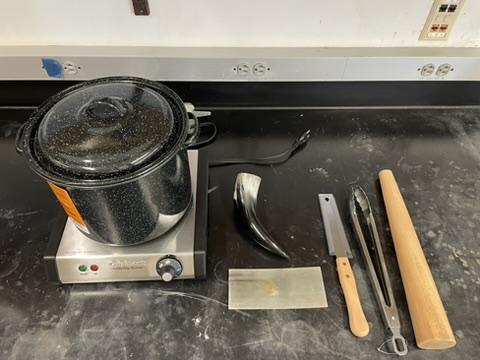
From left to right: hotplate, pot, small bovine horn, flattened bovine horn sheet, Japanese pull saw, tongs, and oval-shaped mandrel.Bring water to boil, remove pot from heat, and place horn sheet and small horn inside.
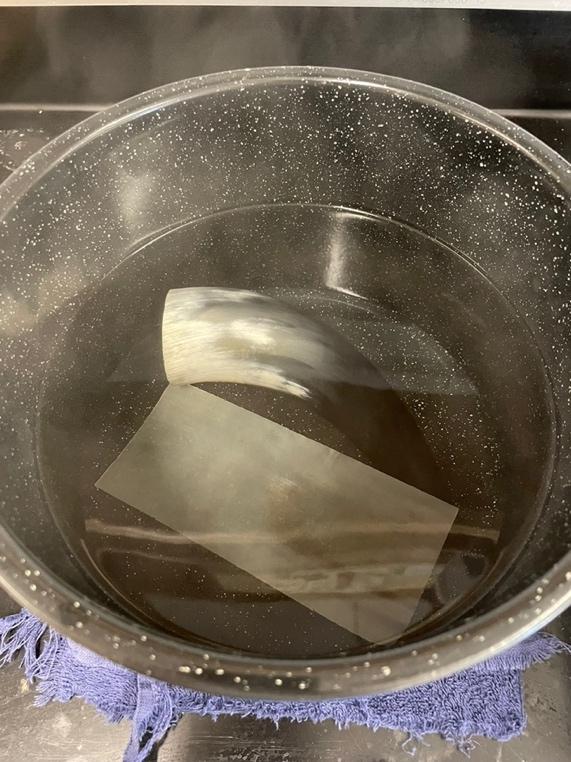
Soaking small horn and flattened horn sheet.After twenty minutes, remove and test for pliability and ease of cutting.
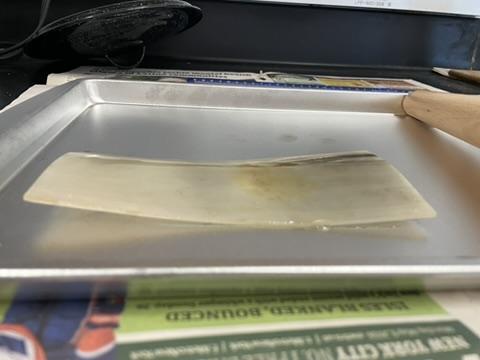
The horn sheet warped from soaking.
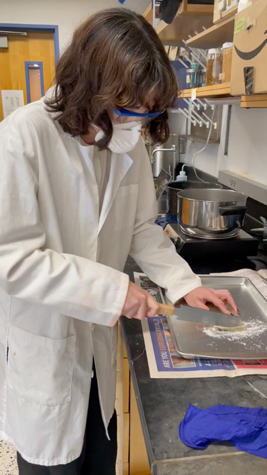
VIDEO - Cutting
horn sheet, made somewhat softer and more pliable through
soaking.
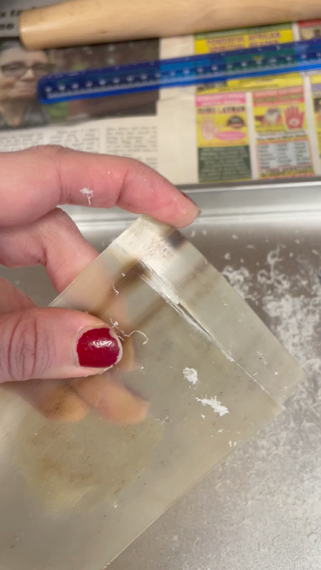
VIDEO - Demonstrating
pliability of horn sheet while cutting.
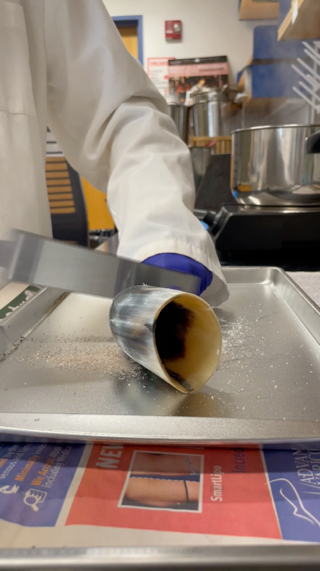
VIDEO - Cutting small horn, made somewhat softer and more pliable through soaking.
Part B: Boiling in Water
For the purposes of my second trial, I interpreted the author-practitioner’s advice to soak in warm water to mean continually heating in water and experimented with boiling the horn directly. I brought a pot of water to a boil, placed one sheet and one small horn inside, and then monitored closely, removing the horn periodically to test for its pliability. After around thirty minutes of boiling, the sheet was warping and when removed, both the sheet and horn were somewhat softer. However, I was still not able to bend the sheet enough to shape it on the mandrel. After two hours, I found that the sheet was bendable and the edges of the horn could be pressed in. I was also able to cut both with greater ease. Again, I found that both cooled very quickly and became more difficult to manipulate but even dipping back into the boiling water momentarily rendered them soft and pliable again. While boiling the horn achieved pliability and bendability, I found myself needing a good deal of pressure to shape the horn and I believe it would require sustained pressure to maintain its shape until cooled completely. I experimented with holding the bent horn in place over the mandrel using pliers and left it to cool. Using this method, the horn successfully hardened into a bent position and maintained this shape.
Process
- Bring water to boil and place horn sheet and small horn inside
pot.
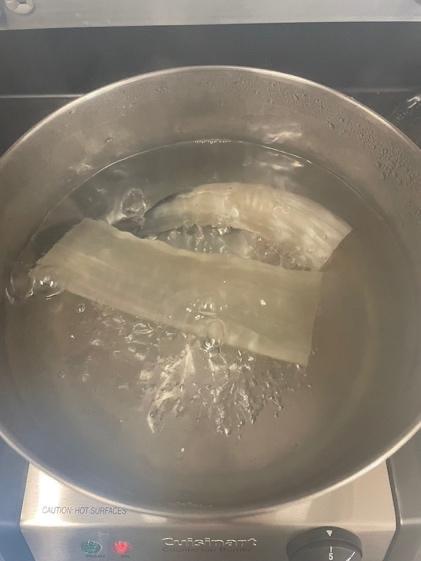
Horn and small sheet boiling
- Boil continually, removing periodically to test for
pliability.
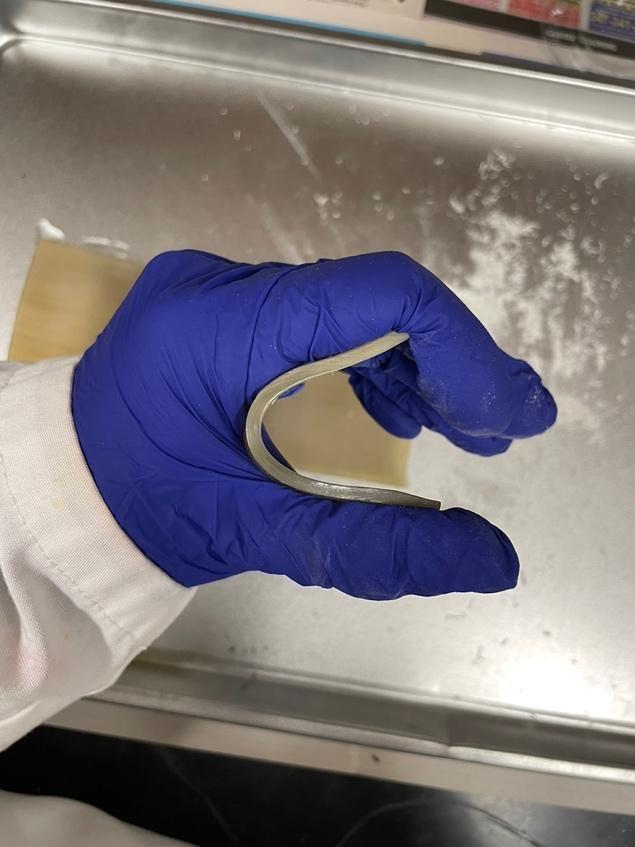
Demonstrating pliability of horn sheet after two hours of
boiling.
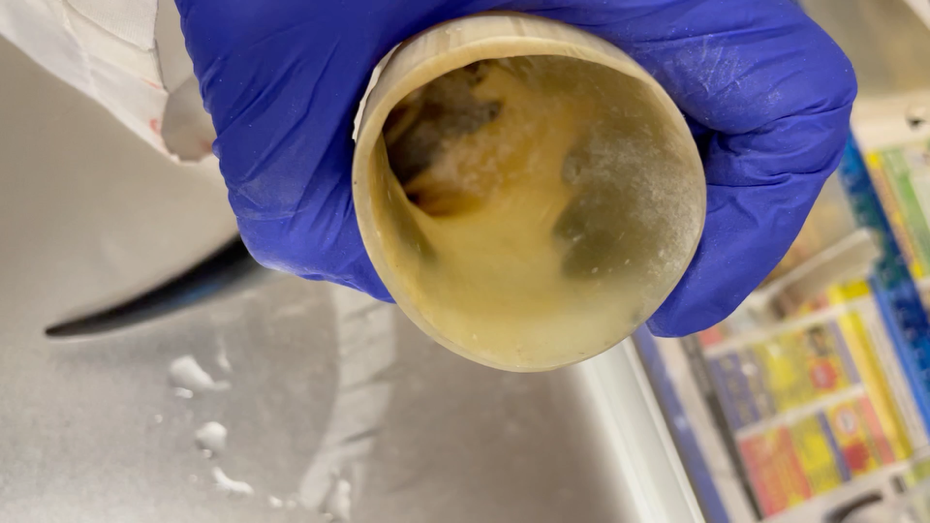
VIDEO - Demonstrating
pliability of small horn after two hours of boiling
- When pliability is achieved, experiment with cutting and shaping
on mandrel.
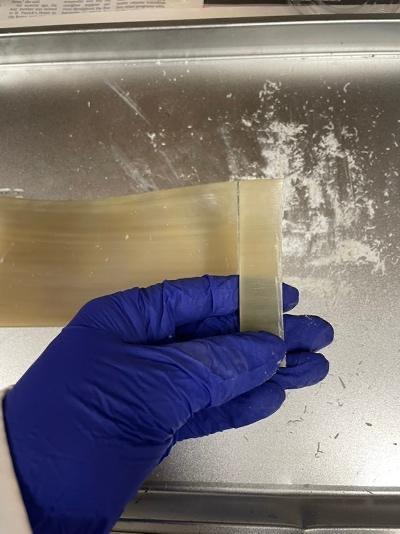
Successful cut from horn sheet after two hours of boiling.
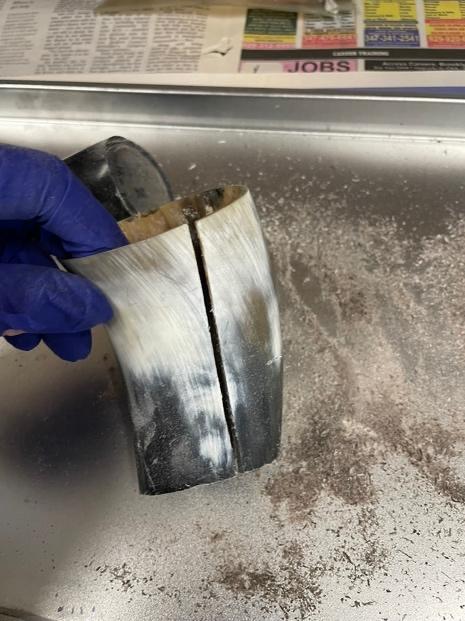
Successful cut from small horn after two hours of boiling.
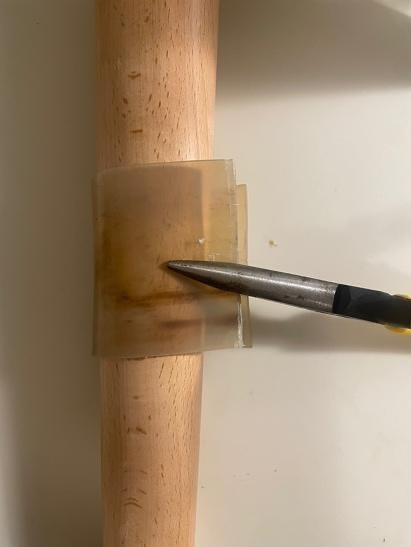
Attempted shaping of horn sheet on mandrel after two hours of
boiling, held in place by pliers to cool and harden.
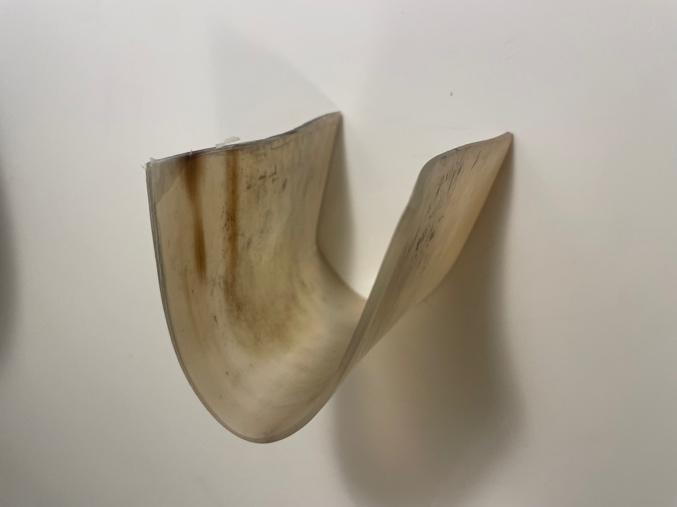
Horn sheet maintaining curved shape after cooling.
3.3.2. Trial 2: Another Way: Recreating Girolamo Cardano’s Recipe to “Amollir les cornes”
| Pour amollir les cornes | To soften horns |
|---|---|
| D’avantage il appartient à l’art d’aclmie et est son euure d’amollir les cornes, ce qui est fait par longue coction, en adioustant un peu de cendre dedens l’eau et faut huit heures pour ce faire. | Furthermore, it belongs to the art of alchemy, and it is its task to soften the horns, which is done by prolonged soaking, adding a little ash to the water, and it takes eight hours to accomplish this. |
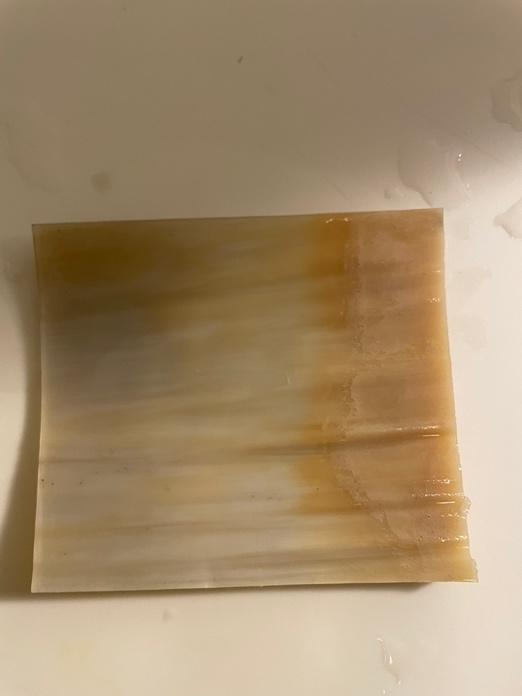
Girolamo Cardano’s sixteenth-century recipe for softening horn instructs one to soften the material through prolonged soaking in water with the addition of a little wood ash. As the recipe does not offer a precise proportion of water to ash, I decided to test mixing 5 oz of wood ash with 50 oz of water. Before soaking the horn, I tested the pH of the mixture and was surprised by how caustic a bath even this small amount of wood ash produced; it had a pH of approximately 12–13. Following Cardano’s instructions, I left the horn to soak for eight hours but checked on it periodically and found that the mixture was quite active, bubbling independently and more rapidly when I inserted tongs, but did not seem to be having an effect on the horn. After eight hours, the wood ash had thoroughly settled to the bottom of the pot, and the water had turned a light brown color resembling lye. However, I found that the horn had not softened. Although Cardano’s recipe specifies eight hours of soaking, I decided to transfer the mixture and horn to a plastic container and continue to monitor its progress with time. I tested it again after six days and found that the horn appeared significantly more opaque and thicker, as if saturated by the liquid. It was also noticeably discolored at the bottom where it had come into contact with the settled ash. I found that it bent easily in my hand. As with Trial 1, I felt that maintaining a bent shape would require significant pressure, so I tested the same method of holding the curved shape with pliers. As the horn’s texture and thickness appeared to have been changed by the mixture, I was unsure if it would be able to return to a hard state in the same manner that the boiled horn had. Indeed, it took longer for the horn to dry out, but when it did, it also fully hardened and maintained the curved shape. However, the color had darkened, and the horn was cracking at its bend.
Process
- Assemble materials.
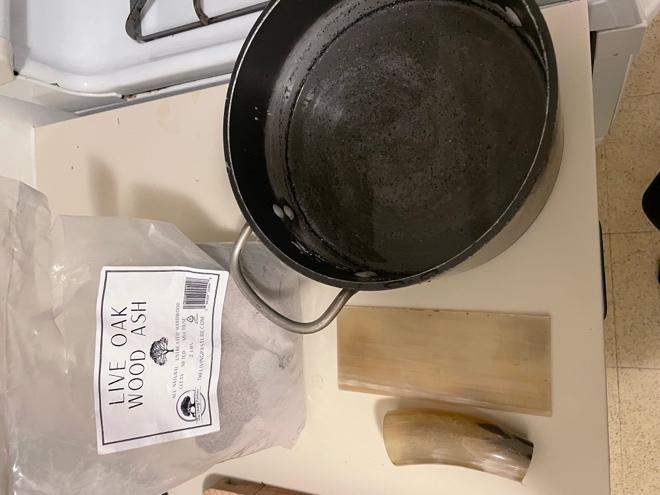
From top left to bottom right: Live oak wood ash, small horn, horn sheet, pot for soaking (later transferred to a plastic container).
- Mix 5 oz of wood ash and 50 oz of water and test pH of
mixture.
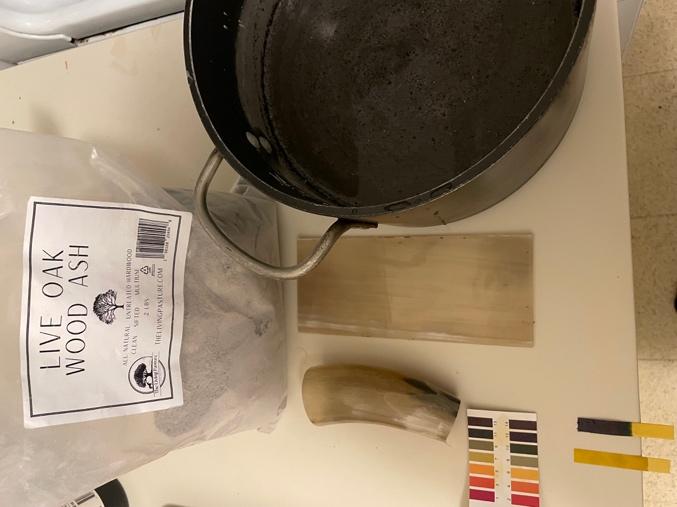
Results of pH test: 12–13.
- Add horn sheet and small horn. Monitor and test for pliability
after 8 hours.
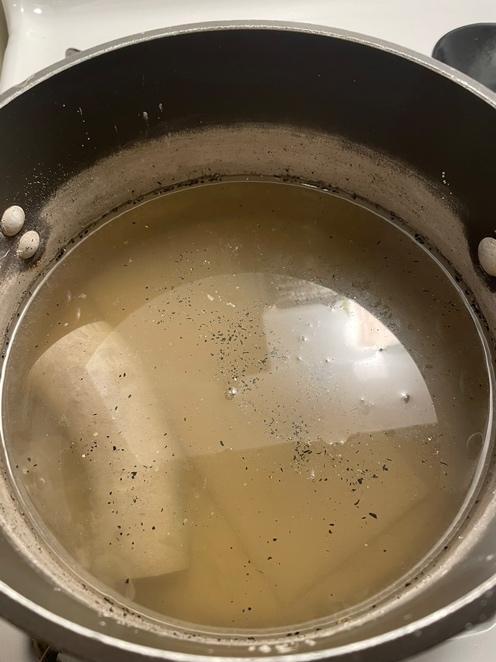
After eight hours, the ash had settled and the water had turned a brown hue, but the horn was not noticeably softened.
- Continue to let soak, monitor, and test periodically for
pliability.
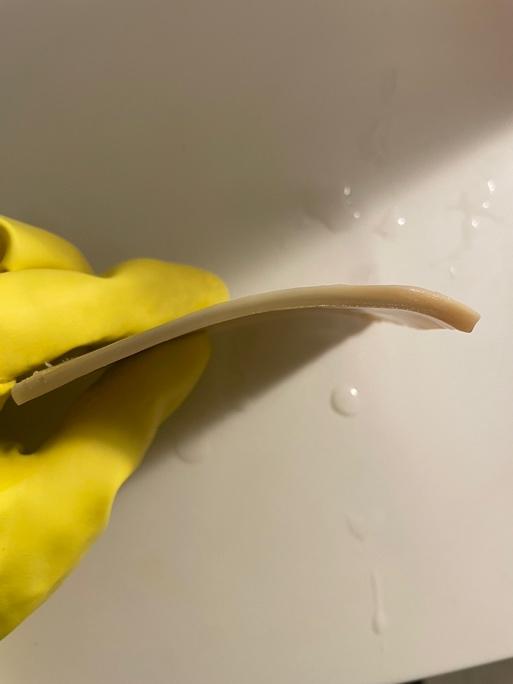
The profile of the horn sheet after six days, noticeably thicker.
The face of the horn sheet after six days, showing its opacity and
discoloration where it came into contact with the ash.
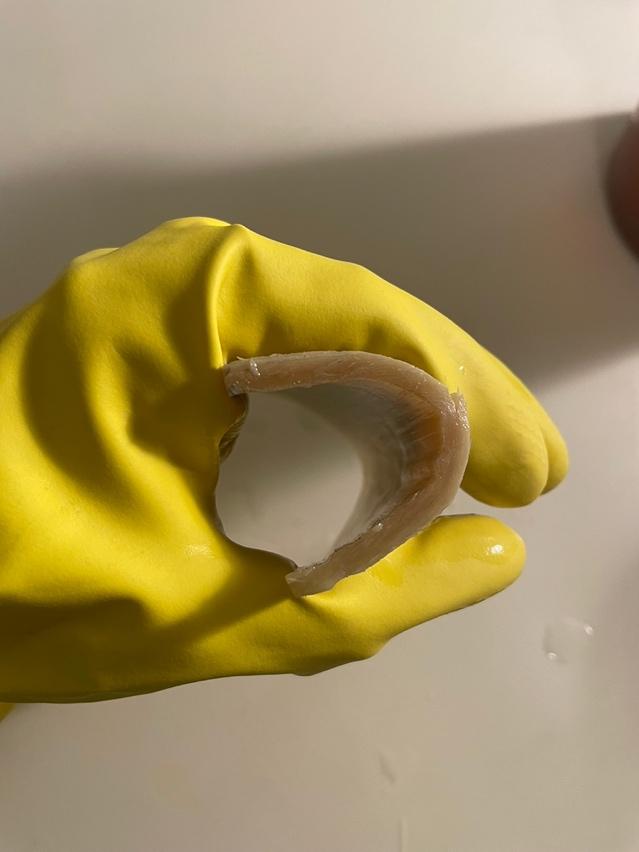
Demonstrating pliability of horn after six days.
- Remove horn from bath and attempt shaping and drying, using
pliers to maintain shape.
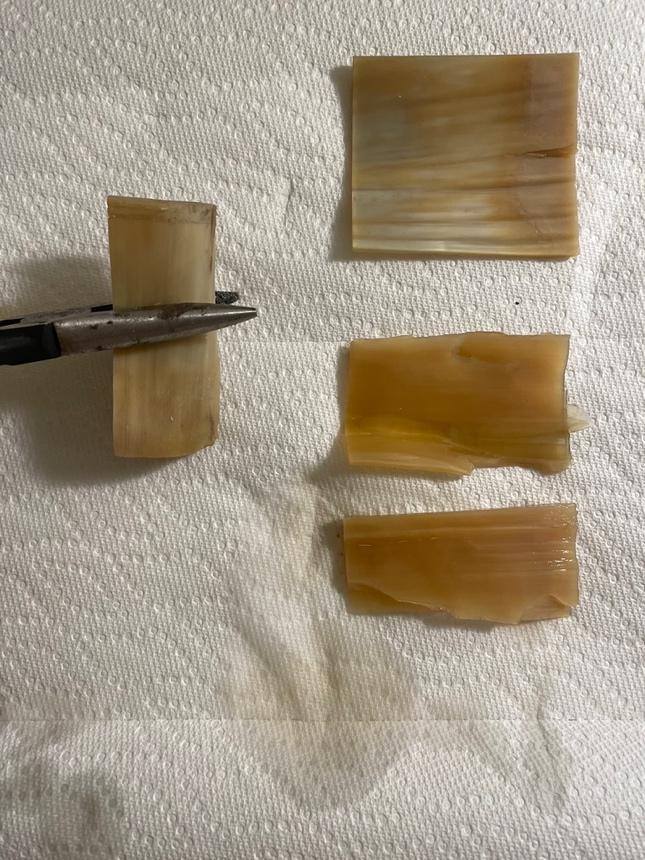
Attempted shaping and drying of horn from Trial 2 at left and top
right.
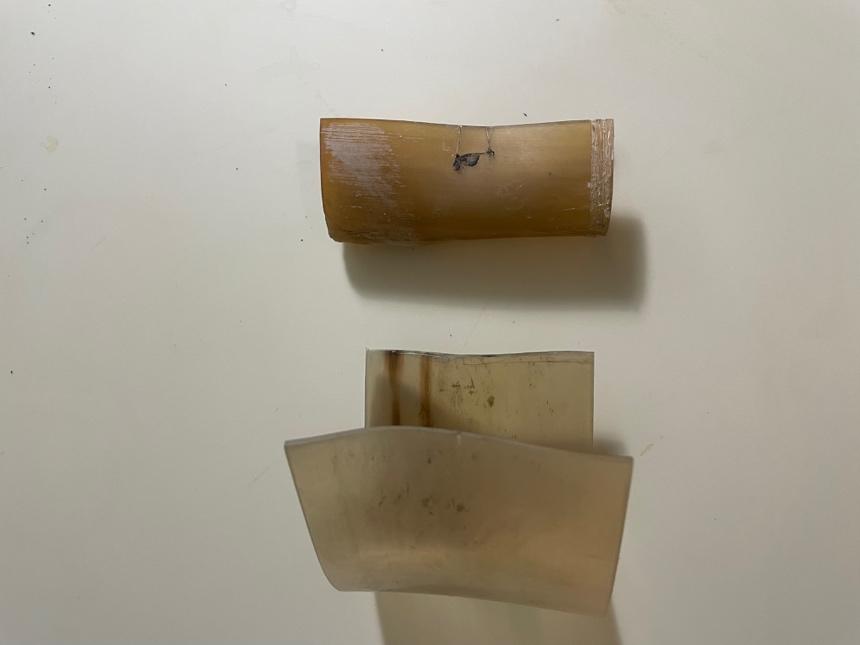
A comparison of the shaped horn from Trial 1 and Trial 2.
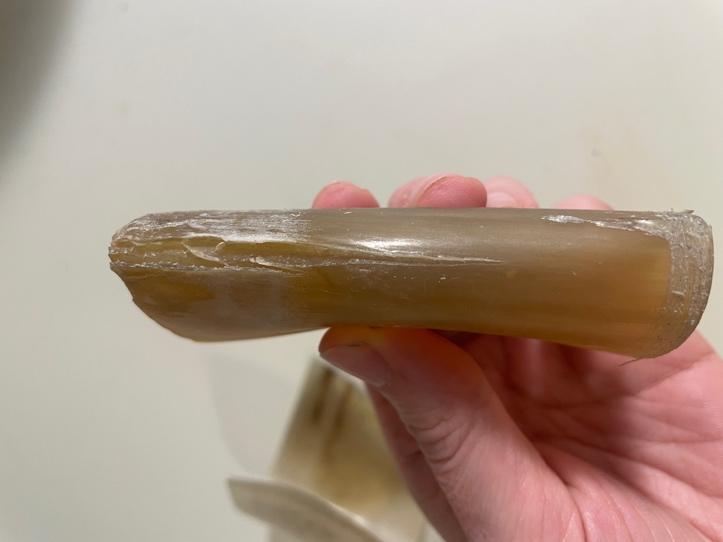
A detail of the shaped horn from Trial 2 showing breakage from bending.
3.3.3. Trial 3: Yet Another Way: Soaking Horn in Woodash Lye
| To make horn soft | To soften horn so much that it can be worked into forms |
|---|---|
Take the urine of a man which has stood covered for four weeks, and one pound of unslaked lime and half the amount of willow ashes or ashes of wine lees, eight loth tartar and the same amount of salt; mix well together and bring to the boil; pour it into a filter bag and let it run twice through; keep this lye well covered. When you want to make horn soft, immerse the horn material therein for eight days, then it will become soft; or take stems from poppies together with their top parts, burn to ashes and make a lye of this, and let the horn boil therein. | Take one pound of the ashes used in making glass, one pound unslaked lime, one “mass” water, allow to boil together until two thirds are evaporated, then stick a feather in and squeeze it between two fingers; if the hairs come off, the boiling has been enough, other wise let boil longer; let it clarify and pour off, put in small chips of horn and let soften for two days, smear oil on your hands and the horn to make a paste and press it into what you wish. |
For my final trial, I attempted to make a wood ash lye inspired by the recipes found in the Allerley Matkel. I did not attempt to fully reconstruct the recipe, but rather to see if a lye made from wood ash alone was sufficient for softening. To make the lye, I initially attempted to boil equal parts water and wood ash (following the Allerley Matkel’s instruction to take one pound of ashes and one “mass” water) but found that the water boiled away too quickly and left me with dry wood ash. I added more water and boiled for around thirty minutes. When the wood ash had settled to the bottom, I was left with a clear darkened mixture. I repeated this procedure three times until I had a sufficient amount of liquid to soak the horn in. I tested the pH of this mixture and found that it was similar to the mixture from Trial 2, approximately 12–13. I also tested it using a feather in the manner described in the Allery Matkel but found that the feather did not dissolve. I made another attempt to concentrate the mixture further through boiling until around two thirds reduced but still found it had the same pH and failed the feather test so decided to proceed with the trial. I inserted the horn and left it to soak overnight. While the Allerley Matkel recommends leaving the horn to soak in this mixture for eight days, I found that with just one night’s soaking, the horn had already become dark, opaque, thick, and saturated like the horn in Trial 2. Some spots had become thin and transparent and appeared as if they might break. Indeed, when I attempted to bend the horn, I found that it bent easily but with light pressure, one of the sheets broke in two and as I handled it, additional small pieces fell off. It was clear that it would not be possible to hold this horn with the pliers in the manner I had employed in Trials 1 and 2 so I did not attempt to keep it in a bent shape as it dried. I did, however, remove it from the mixture to test if it would fully harden as it dried. Again, I was surprised to find that while it took longer to dry than the horn had in either Trial 1 or 2, it did eventually return to a totally hardened state.
Process
- Prepare lye by boiling a mixture of water and wood ash. Note that
while I began with equal parts water and wood ash, I found that I needed
to add more water to the mixture. Leave to boil for approximately thirty
minutes.
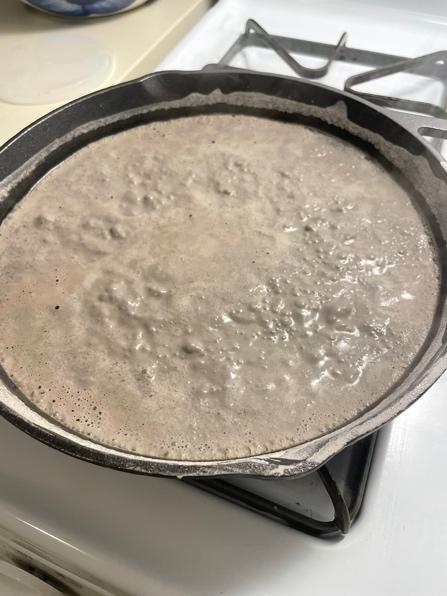
The water and wood ash mixture boiling.
- Leave until ash has settled at the bottom of the pot.
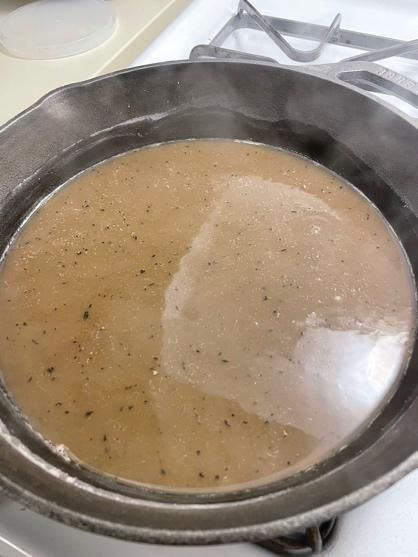
The mixture after the wood ash had settled.
Repeat procedure until you have a sufficient amount of liquid for soaking horn.
Test the pH of the mixture using pH test strips and feather test.
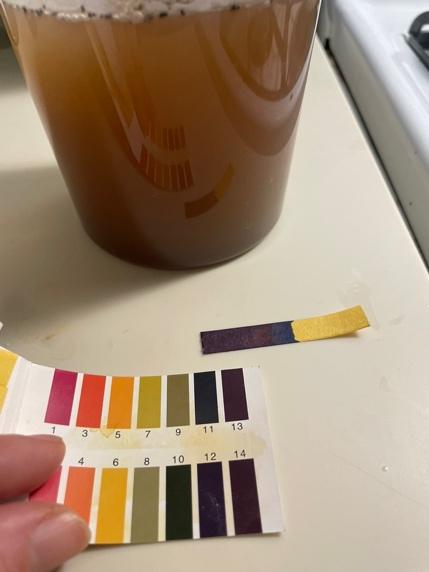
Results of the pH test: 12–13
- Add horn to mixture and leave to soak, monitoring progress and
testing pliability.
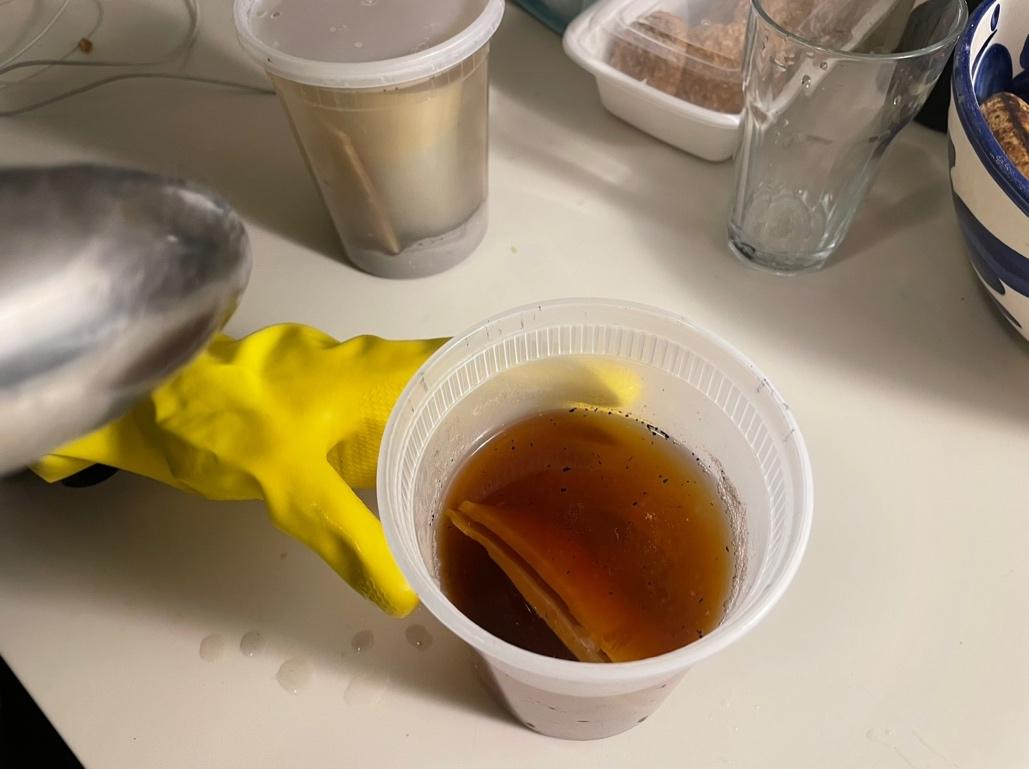
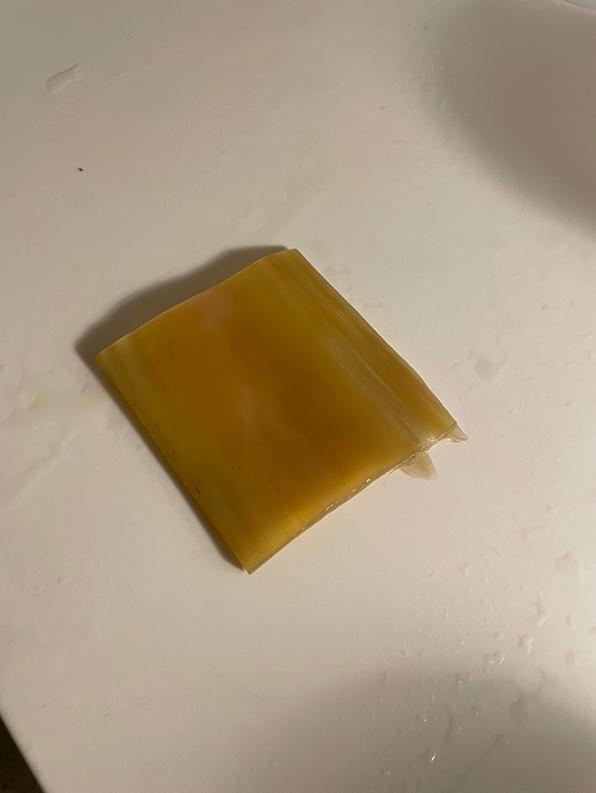
After one night, the horn was already darkened, opaque, and
saturated.
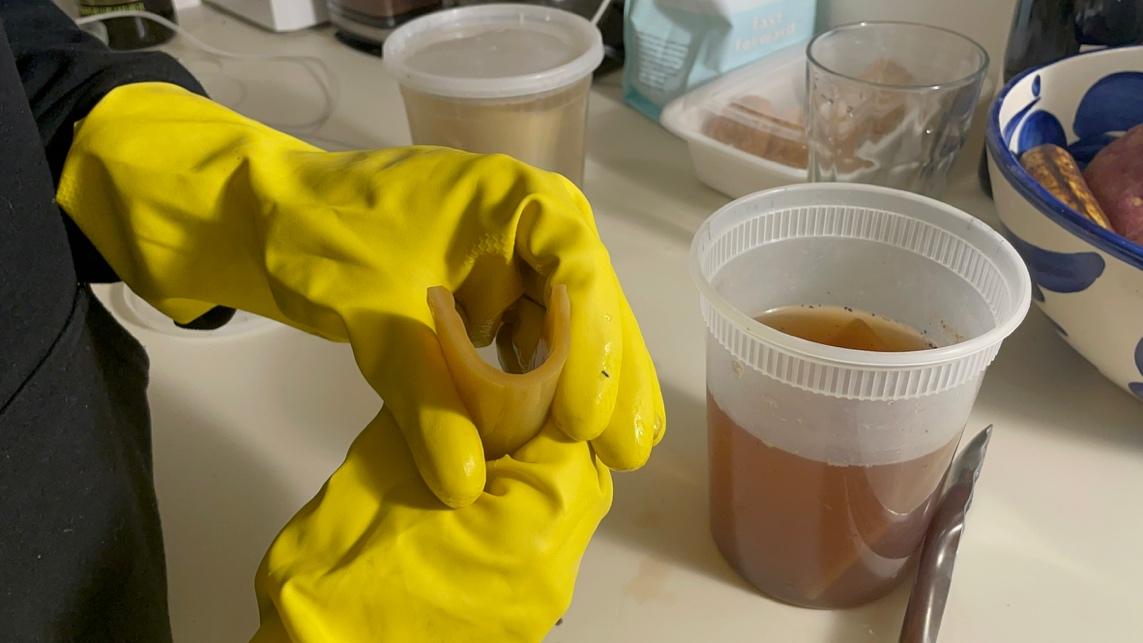
Demonstrating pliability of horn after one night.
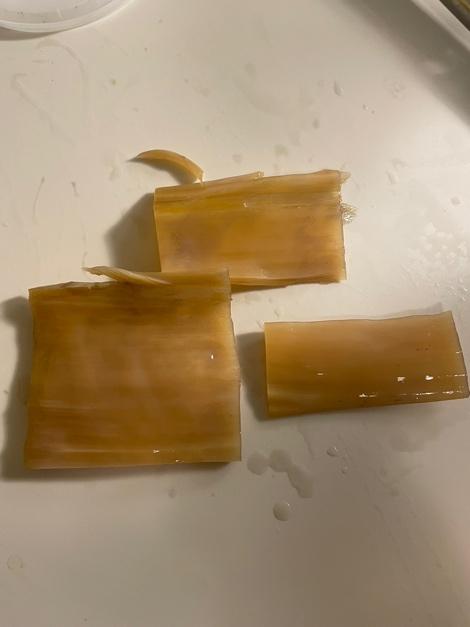
Horn broken into pieces from handling.
- Remove horn from mixture and test if it will fully dry and
harden.
Attempted drying of horn from Trial 3 at bottom left.
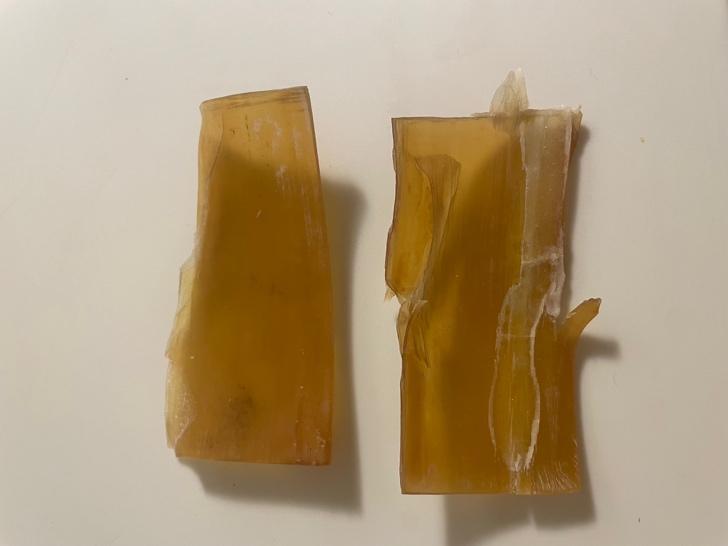
Dried pieces, also showing breakages and flaking.
4. Reflection and Conclusions
4.1. Proof of Concept
Although my experiments are far from conclusive, ultimately, all three trials can be considered effective in the sense that they rendered the horn soft, the stated goal of each recipe. In the case of Ms. Fr. 640’s recipe, after conducting my experiments, I believe that the author-practitioner intended continual heating of the horn through simmering or boiling and this did prove to be a highly effective means of softening the horn. However, in order to truly mold the material into rounded shapes for mounting agnus dei or producing circular or oval boxes, additional tools beyond a triblet or mandrel would be necessary to apply the necessary pressure and hold the horn in place until fully cooled and hardened. Indeed, while the recipe describes the kind of objects that softened horn might eventually be used to produce, the recipe itself, like the others discussed here, is technically only for softening horn, which may explain the lack of further details concerning the tools and processes required for shaping or molding.
Soaking in caustic solutions also proved to be an effective means of softening horn but yielded a number of side effects, staining the horn and rendering it susceptible to cracks and breakage. Depending on the product to be crafted, these side effects may or may not have proven undesirable or fatal.
4.2. Horn’s Material Affordances, Resistances, and Limits
My experience of reconstruction enabled me to experience horn’s material affordances and resistances firsthand. As I boiled the horn in water, I felt as if I unlocked its natural capacity and hidden potential for manipulation. As I attempted working the horn on the mandrel, I found that it was cooling and hardening too quickly and began to dip the horn back in the boiling water briefly as I continued to handle it. I was amazed that a seconds-long plunge could turn the quickly hardening material immediately malleable once again. It was in these moments especially that I understood the “seulement” of Ms. Fr. 640’s recipe. Boiling horn felt like a surprisingly simple procedure to effect such a transformation. The change was not affected by my skill or technique but my familiarity with this simple procedure built on a basic understanding of horn’s innate capacities. Within the larger context of circulating recipes for softening, molding, and even pouring horn, the author-practitioner’s recipe might be read as practical advice drawn from a knowledgeable source familiar with the innate properties of horn which allowed for working and manipulation into desired shapes with only minimal intervention. Like my reconstructions, practical experience would have proven that it was not necessary to alter or transform the material through any artful means, one only needed to unlock the alterability and transformability innate to horn. At least to mount agnus dei and make certain little boxes, all that was needed was “seulement” soaking horn.
The caustic solutions suspended horn’s tendency to return to its natural state. Saturated by the mixture, the horn remained soft and manipulable for hours rather than seconds. Extending this manipulability could have facilitated making new forms but it also risked pushing the material beyond its limits, causing unintended changes in color or breaks or even leading the substance to dissolve. In both cases, however, I was struck by the horn’s resiliency. It was difficult to imagine that the softened, swollen, almost gelatinous material that I removed from the caustic baths would return to a fully hardened state. Nonetheless, in both trials, with time, the horn dried and thoroughly hardened. Horn’s incredible tendency to return to its original state even after subjection to extreme conditions might have encouraged early modern artisans in their continual experiments with the material.
Bibliography
Primary Sources
Ms. H 1435, John Rylands Library, Manchester. https://www.digitalcollections.manchester.ac.uk/view/MS-GASTER-HEBREW-01435/46.
Boileau, Étienne. Réglemens sur les arts et métiers de Paris. Edited by G.-B Depping. Paris, 1837.
Cardano, Girolamo. *Les Livres de Hierosme Cardanus medecin milannois. intitules de la * Subtilité, et subtiles inventions, ensemble les causes occultes, et raisons d’icelles. Translated by Richard le Blanc. Paris, 1556.
Diderot, Denis and Jean le Rond d’Alembert, eds. Encyclopédie ou Dictionnaire raisonné des sciences, des arts et des métiers, Planches. Vol. 9. Paris, 1765.
Edelstein, Sidney M. “The Allerley Matkel (1532): Facsimile Text, Translation, and Critical Study of the Earliest Printed Book on Spot Removing and Dyeing.” Technology and Culture 5, no. 3 (Summer 1964): 297–321.
Lémery, Nicolas. Le nouveau recueil de curiositez rares & nouvelles des plus admirables effets de la nature & de l’art : composé de quantité de beaux secrets galans & autres dont quel-que uns ont été tirez du cabinet de feu Monsieur le marquis de l’Hôpital. 1 / expérimentez & composez par le sieur d’Emery. Paris: P. Vander, 1685.
——. Modern Curiosities of Art & Nature Extracted Out of the Cabinets of the Most Eminent Personages of the French Court: together with the choicest secrets in mechanicks, communicated by the most approved artists of France / composed and experimented by the Sieur Lemery, apothecary to the French king ; made English from the original French. London: Matthew Gilliflower and James Partridge, 1685.
Lamour, Nouveau manuel de l’ébéniste. Paris, 1838.
Pausanias. Description of Greece. Translated by Jones, W. H. S. and Omerod, H. A. Loeb Classical Library Volumes. Cambridge, MA, Harvard University Press; London, William Heinemann Ltd. 1918.
Strype, John. A survey of the cities of London and Westminster. London, 1720.
Secondary Sources:
Baker, Katherine. A Merchant of Ivory in 16th-Century Paris: The Estate Inventory of Chicart Bailly. Brill, 2023.
Guérin, Sarah. French Gothic Ivories: Material Theologies and the Sculptor’s Craft. Cambridge University Press, 2022.
Hardwick, Paula. Discovering Horn. Lutterworth Press, 1981.
Lapatin, Kenneth D. S. “Pheidas ἐλεφαντουργός,”American Journal of Archaeology 101 (1997): 663–82. https://www.journals.uchicago.edu/doi/pdfplus/10.2307/506829.
Lehmann, Ann-Sophie. “The Matter of Medium: Some Tools for an Art-Theoretical Interpretation of Materials.” In The Matter of Art: Materials, Practices, Cultural Logics, c. 1250–1750. Edited by Christy Anderson, Ann Dunlop, and Pamela H. Smith. Manchester, 2014.
MacGregor, Arthur. Bone, Antler, Ivory and Horn: The Technology of Skeletal Material Since the Roman Period. Croom Helm, 1985.
Pitman, Sophie. “Daily Life and Material Culture in Early Modern Europe.” In Secrets of Craft and Nature in Renaissance France. A Digital Critical Edition and English Translation of BnF Ms. Fr. 640, edited by Making and Knowing Project, Pamela H. Smith, Naomi Rosenkranz, Tianna Helena Uchacz, Tillmann Taape, Clément Godbarge, Sophie Pitman, Jenny Boulboullé, Joel Klein, Donna Bilak, Marc Smith, and Terry Catapano. New York: > Making and Knowing Project, 2020. DOI: https://www.doi.org/10.7916/ebsm-h148.
Schaverien, Adele. Horn: Its History and its Uses. Lexington, KY: Brécourt Academic, 2006.
Sears, Elizabeth. “Ivory and Ivory Workers in Medieval Paris.” In Images in Ivory: Precious Objects of the Gothic Age, edited by Peter Barnet. The Detroit Institute, 1997.
Smith, Pamela H. The Body of the Artisan: Art and Experience in the Scientific Revolution. The University of Chicago Press, 2004.
——. From Lived Experience to the Written Word: Reconstructing Practical Knowledge in the Early Modern World. The University of Chicago Press, 2022.
Smith, Pamela H., Tianna Helena Uchacz, Sophie Pitman, Tillmann Taape, and Colin Debuiche. “The Matter of Ephemeral Art: Craft, Spectacle, and Power in Early Modern Europe.” Renaissance Quarterly 73, no. 1 (2020): 78–131. https://doi.org/10.1017/rqx.2019.496.
St. Clair, Archer and Elizabeth Parker McLachlan. “The Carvers Art: Medieval Sculpture” in Ivory, Bone, and Horn. The State University of New Jersey, 1989.
“Our History,” The Worshipful Company of Horners, last accessed December 15, 2025. https://www.horners.org.uk/the-company/our-history-plus/. ↩︎
Pausanias, Description of Greece, trans. Jones, W. H. S. and Omerod, H. A. Loeb Classical Library Volumes. (Harvard University Press, 1918), Book 5.12.2. ↩︎
Adele Schaverien, Horn: Its History and its Uses (Brécourt Academic, 2006) and Paula Hardwick, Discovering Horn (Lutterworth Press, 1981) both provide very useful historical overviews of horn, particularly of horn working in medieval and early modern England, and catalogues of the various products fashioned from horn. ↩︎
Étienne Boileau, Réglemens sur les arts et métiers de Paris, edited by G.-B Depping (Paris, 1837): Titre XXVII (Des patenotriers d’os et de or), p. 66, Titre LXVIII (De ceus qui font tables à escrire á Pariss), p. 171, Titre LXVII (Des Pingniers et des Lanterniers de Paris), Titre LXXI (Des Deiciers de Paris), p. 180. ↩︎
Sarah Guérin, French Gothic Ivories: Material Theologies and the Sculptor’s Craft (Cambridge University Press, 2022), 33–41. Elizabeth Sears,“Ivory and Ivory Workers in Medieval Paris,” in Images in Ivory: Precious Objects of the Gothic Age, ed. Peter Barnet (The Detroit Institute, 1997), 19–37. ↩︎
Guérin, French Gothic Ivories, 35–36. ↩︎
Katherine Baker, A Merchant of Ivory in 16th-Century Paris: The Estate Inventory of Chicart Bailly (Brill, 2023). ↩︎
Denis Diderot and Jean le Rond d’Alembert, eds., Encyclopédie ou Dictionnaire raisonné des sciences, des arts et des métiers, Planches, vol. 9 (Paris, 1765), plates I-XVI. ↩︎
Schaverien, Horn, 10. ↩︎
John Strype, A survey of the cities of London and Westminster (London, 1720), vol. 1, book 2, p. 28. ↩︎
“Paindre a huile desmail dazur,” 11r. ↩︎
“Gect de plomb,” 49r. ↩︎
Sophie Pitman, “Daily Life and Material Culture in Early Modern Europe,” in Secrets of Craft and Nature in Renaissance France. A Digital Critical Edition and English Translation of BnF Ms. Fr. 640, ed. Making and Knowing Project, Pamela H. Smith, Naomi Rosenkranz, Tianna Helena Uchacz, Tillmann Taape, Clément Godbarge, Sophie Pitman, Jenny Boulboullé, Joel Klein, Donna Bilak, Marc Smith, and Terry Catapano (New York: Making and Knowing Project, 2020). DOI: https://www.doi.org/10.7916/ebsm-h148, fig. 3. ↩︎
Thin pieces of horn were similarly used as protection for relics in medieval reliquaries as in the Mosan Reliquary Panel of the Triumphant Christ, panel: late 11th century and frame: 13th century. Walters Art Museum, Baltimore, 57.519. In the thirteenth century, when the panel was modified into a reliquary, small cavities were added to its frame to house relics and thin horn sheets were added as protective windows. ↩︎
Hardwick, Discovering Horn, 96. ↩︎
Girolamo Cardano, Les Livres de Hierosme Cardanus medecin milannois. intitules de la Subtilité, et subtiles inventions, ensemble les causes occultes, et raisons d’icelles, trans. from Latin to French by Richard le Blanc (Paris, 1556), 339. ↩︎
Schaverien, Horn, 119–20. ↩︎
See, for just one example, the use of “certain” to describe the material characteristics of some butterflies and plants in the recipe for casting “Animaulx a poil et fleurs foibles et fort tanvres” (Animals with hair and fragile and very thin flowers): “Le corps des papillons et les herbes qui ont la tige & les foeilles bourrues de certain poil follet & lanugineulx” (the bodies of butterflies and plants that have stem & leaves which are wooly with a certain capricious & downy hair), 124r. ↩︎
See references to “horn from which one makes lanterns, quite thin “(la corne dequoy on faict les lanternes, bien deliee ) in the recipe for Counterfeit jasper (Jaspe contrefaict), 15v and “very clear lantern horn” (corne de lanterne bien claire) in the recipe for Fanciful Tables (Tables fantasques), 68r. ↩︎
Schaverien, Horn, 47–48. For the first heating, when horn is cut open and flattened, she recommends 270 °F but specifies that for a second heating, when flattened horn is shaped into spoon bowls, shoehorns, or box shapes, a lower temperature is required. ↩︎
Cardano, Les Livres, 339. ↩︎
Sidney M. Edelstein, “The Allerley Matkel (1532): Facsimile Text, Translation, and Critical Study of the Earliest Printed Book on Spot Removing and Dyeing,” Technology and Culture 5, no. 3 (Summer 1964): 320–21. ↩︎
Raphael Patai, The Jewish Alchemists: A History and Source Book (Princeton University Press, 1994), 381–92. ↩︎
Nicolas Lémery, Le nouveau recueil de curiositez rares & nouvelles des plus admirables effets de la nature & de l’art : composé de quantité de beaux secrets galans & autres dont quel-que uns ont été tirez du cabinet de feu Monsieur le marquis de l’Hôpital. 1 / expérimentez & composez par le sieur d’Emery (Paris: P. Vander, 1685), 168. ↩︎
Nicolas Lémery, Modern Curiosities of Art & Nature Extracted Out of the Cabinets of the Most Eminent Personages of the French Court: together with the choicest secrets in mechanicks, communicated by the most approved artists of France / composed and experimented by the Sieur Lemery, apothecary to the French king ; made English from the original French. London: Matthew Gilliflower and James Partridge, 1685. ↩︎
See, for example, Arthur MacGregor’s discussion in, Bone, Antler, Ivory and Horn: The Technology of Skeletal Material Since the Roman Period (Croom Helm, 1985), 63–66, as well as Archer St. Clair and Elizabeth Parker McLachlan, The Carvers Art: Medieval Sculpture in Ivory, Bone, and Horn (The State University of New Jersey, 1989), 19. ↩︎
Schaverien,* Horn, 51–52. ↩︎
Kenneth Lapatin notes a similar tendency among scholars concerning the ancient and medieval practice of softening ivory despite philological and archaeological evidence. He has conducted successful reconstructions in his own work, Kenneth D. S. Lapatin, “Pheidas ἐλεφαντουργός,” American Journal of Archaeology 101 (1997): 663–82, https://www.journals.uchicago.edu/doi/pdfplus/10.2307/506829. ↩︎
See Chapter 4 “Artisanship, Alchemy, and a Vernacular Science of Matter,” in Pamela H. Smith, The Body of the Artisan: Art and Experience in the Scientific Revolution (The University of Chicago Press, 2004), 129–54. On the transformation of materials as a fundamental part of artistic practice, including liquifying solid materials like stone or horn, also see Pamela H. Smith, Tianna Helena Uchacz, Sophie Pitman, Tillmann Taape, and Colin Debuiche, “The Matter of Ephemeral Art: Craft, Spectacle, and Power in Early Modern Europe.” Renaissance Quarterly 73, no. 1 (2020): 82, 125. ↩︎
Pamela H. Smith, From Lived Experience to the Written Word: Reconstructing Practical Knowledge in the Early Modern World (The University of Chicago Press, 2022), 127, 133. ↩︎
See for example the recipes concerning horn in Lamour, Nouveau manuel de l’ébéniste (Paris, 1838), 185–89. ↩︎
A number of scholars working in the material turn have borrowed the term “affordances” from psychologist James Gibson to describe a material’s natural properties which shape how artisans handle them. See for example, Ann-Sophie Lehmann, “The Matter of Medium: Some Tools for an Art-Theoretical Interpretation of Materials,” in The Matter of Art: Materials, Practices, Cultural Logics, c. 1250–1750, edited by Christy Anderson, Ann Dunlop, and Pamela H. Smith (Manchester, 2014), 21–41. ↩︎